
Active Warrants in Lucas County
Lucas County warrants are issued by the court that has jurisdiction over the case. The Court of Common Pleas General Division issues warrants for felony matters. Toledo, Sylvania, Maumee, and Oregon Municipal Courts issue their own warrants for misdemeanor, traffic, and local ordinance cases. Each court tracks its own active warrants in its own docket system. There is no single countywide public database that combines every open warrant from all of these courts into one searchable list.
The Lucas County Clerk of Courts criminal division FAQ directly addresses this gap. When someone asks "Do I have any warrants?" the FAQ tells them to contact the municipal court of jurisdiction and use "Which Court is Mine" to identify the right court. That direction points to city-level courts rather than a county-wide system. This reflects how Ohio structures its warrant records: they live with the issuing court, not in a county clearinghouse.
Sylvania Municipal Court is the exception. Its official website at sylvaniacourt.com lists an Active Warrant List under its Bonds and Warrants section. That list covers warrants issued by Sylvania Municipal Court. It does not cover Toledo, Maumee, Oregon, or Common Pleas warrants. If the person you are searching for has ties to the Sylvania area, that is the best public starting point in the county.
The Lucas County Sheriff's Office at lucascountysheriff.org handles warrant service for the county and maintains contact with issuing courts. The Sheriff does not publish a searchable active-warrant database. The Sheriff's Booking Summary shows people who have already been booked into the Lucas County Corrections Center, which is not the same as a warrant list. Someone on a warrant list may not yet have been arrested, and someone already booked may have had their warrant executed and cleared.
Important: Jail visitor checks at Lucas County Corrections Center include a full warrant search. Visitors with active warrants are turned away. Review your own warrant status before going to the jail; see inmate records for jail information.
Types of Lucas County Warrants
Ohio law and local courts recognize several distinct warrant types. Each one is issued under different circumstances and carries different consequences. Some warrants result in immediate arrest. Others are civil tools used to compel a person to appear. Knowing the difference matters when you are trying to find out if a warrant exists and what steps to take next.
| Warrant Type | Who Issues It | Common Trigger | Typical Outcome |
|---|---|---|---|
| Arrest Warrant | Judge or magistrate | Probable cause for a crime | Law enforcement arrests the named person |
| Bench Warrant / Capias | Court after case begins | Missed court date, contempt, probation violation | Person brought to court; bond may be set or raised |
| Search Warrant | Judge, per ORC 2933.21 | Probable cause to search a place or person | Peace officer executes search; return filed with court |
| Fugitive Warrant | Out-of-county or out-of-state court | Person fled jurisdiction after charge or conviction | Extradition proceedings or hold for pickup by other jurisdiction |
| Civil / Body Attachment | Court in civil or support proceeding | Failure to pay support, contempt of civil order | Person held until compliance or hearing |
Search warrants deserve a separate note. Under ORC 2933.21, a search warrant is a written order issued in the name of the state, signed by a judge, and directed to a peace officer. It commands the officer to search a specific place or person and seize described property or evidence. Search warrants differ from arrest warrants because they target places or things, not just people. Search warrant affidavits and supporting materials often remain sealed while an investigation is active, so they may not appear in ordinary public docket searches even if the warrant has been executed.
A bench warrant, sometimes called a capias, is the most common warrant type seen in Lucas County court dockets. It arises when someone does not show up for a scheduled hearing, violates conditions of release, or ignores a court order. The court enters the warrant in the case docket, and law enforcement can then arrest the person at any time. Many bench warrants stay active for years if no one picks up the person or if the person never returns to court.
How to Search Lucas County Warrants
Because no single portal covers every warrant in the county, you need to know which court likely issued the warrant before you search. The steps below walk through the best public options.
- Identify the court of jurisdiction. Look at the ticket, citation, or charging document. The case number prefix or the court name printed on it tells you which court. For Common Pleas felonies, prefix codes like CR, LR, or MS appear. For municipal matters, the issuing agency's jurisdiction points to Toledo, Maumee, Sylvania, or Oregon Municipal Court.
- Check the Sylvania Municipal Court Active Warrant List. If the matter falls in Sylvania's jurisdiction, visit sylvaniacourt.com and look under Bonds and Warrants. This is the only court in Lucas County that publishes a named warrant list publicly.
- Search the Toledo Municipal Court case system. For Toledo area matters, use the Toledo Municipal Court case information tool. Select Criminal/Traffic Case Information and search by name or case number. Open the case and look for warrant entries or capias notations in the docket.
- Contact Maumee Municipal Court. Maumee does not appear to publish a public warrant list. Call 419-897-7136 or email court@maumee.org to ask about outstanding matters in that court's jurisdiction, which covers Maumee, Waterville, Whitehouse, Waterville Township, and parts of Lucas County south of the Ohio Turnpike.
- Search or call the Lucas County Clerk for Common Pleas matters. The Clerk of Courts at lucascountyoh.gov directs warrant questions to the municipal court of jurisdiction, but felony warrant entries may appear in Common Pleas dockets through re:SearchOH or Justice Case Access. The Criminal Division can also be reached at 419-213-4480.
- Do not rely on unofficial aggregator sites. Third-party warrant databases are often outdated, incomplete, or inaccurate. Go directly to the issuing court or the Clerk's official portal for reliable information.
Note: The Lucas County Sheriff's non-emergency line at 419-255-8443 can confirm whether a particular person is wanted for a warrant, though the Sheriff does not run a public online search tool for this purpose.
Lucas County Warrant Search Fields by Court
Each court in Lucas County uses a different system with different search fields. The table below covers the main public-facing tools where warrant or capias information may surface. Field availability depends on the court and system.
| Court / Tool | Search Fields Available | Account Required | Notes |
|---|---|---|---|
| Sylvania Municipal Court Active Warrant List | Name-based list (browse) | No | Public list; covers Sylvania jurisdiction only |
| Toledo Municipal Case Info (Criminal/Traffic) | Name, case number, date range | No | Docket shows warrant/capias entries when present |
| Sylvania Court Server (courtsvr) | Name, case number | No | Linked from sylvaniacourt.com for case search |
| re:SearchOH / Justice Case Access (Common Pleas) | Name, case number, date range | Yes (free account) | General Division felonies; warrants appear in case docket |
| Maumee Municipal Court | Phone or email inquiry only | No | No public online search for warrants; call 419-897-7136 |
For the Tyler-based portals covering Common Pleas General Division cases, the account creation is free and credentials from re:SearchOH also work in Justice Case Access. Once logged in, a name search returns matching cases. You can then open a case and scroll through docket entries to see whether a bench warrant or capias has been issued and whether it has been recalled or executed.
What a Lucas County Warrant Record Shows
Warrant entries in court dockets typically appear as journal entries or case events rather than as a separate public document. The content available depends on which court issued it and what the docket system exposes publicly. The table below lists the fields that commonly appear when a warrant or capias entry is found in a Lucas County case docket.
| Field | What It Shows |
|---|---|
| Warrant / Capias Type | Labels the type of warrant, such as bench warrant, arrest warrant, or capias, as entered by the court clerk |
| Issue Date | Date the court issued or journalized the warrant; useful for confirming it is still active or has been resolved |
| Charge or Reason | The underlying charge or court-order violation that prompted the warrant, such as failure to appear or contempt of court |
| Bond Amount | If set by the court, shows how much bond must be posted to secure release after the warrant is executed |
| Issuing Court | The court that issued the warrant, for example Toledo Municipal Court or Lucas County Court of Common Pleas |
| Case Number | The case to which the warrant is attached; use this to pull the full docket and see prior hearings and dispositions |
| Status | Whether the warrant is listed as active, recalled, or executed; status may lag after resolution depending on when the clerk updates the docket |
Full warrant documents, including supporting affidavits and any sealing orders, are usually not visible through ordinary public docket searches. Some warrant-related documents stay sealed during an active investigation and only become public after the warrant is executed and the case moves forward. For those records, a formal public-records request to the Clerk or court may be needed, and some materials may remain restricted under Ohio law even after execution.
How to Resolve a Lucas County Warrant
An outstanding warrant does not go away on its own. It stays active in the court's system until it is executed, recalled, or resolved. Acting quickly can reduce the risk of an unexpected arrest and may give you more options. The steps below apply broadly to Lucas County warrants, though the specifics vary by court and warrant type.
- Identify the court that issued the warrant. Check the ticket, case number, or prior court papers. Use the case number prefix or the court name to find which court holds the case. For Toledo Municipal matters, confirm through the case information site. For Sylvania warrants, check the Active Warrant List. For Common Pleas felonies, search the Clerk's Tyler portals or call the Criminal Division at 419-213-4480.
- Search the court docket or call the clerk. Once you know the court, pull up the case online or call the clerk's file room. Ask whether the warrant is still active, whether a bond amount has been set, and whether any recall options exist. Common Pleas Criminal File Room is reachable at 419-213-4483.
- Ask about recall options. Many bench warrants can be recalled if you contact the court before law enforcement finds you. Options vary, but courts sometimes allow a new court date, payment of outstanding fines or costs, bond posting, or a voluntary appearance. Not all warrants are recallable; the court makes that decision.
- Consult an attorney before surrendering. If there is any risk of arrest, speak with a lawyer first. An attorney can sometimes arrange a voluntary surrender, negotiate bond terms, and appear with you in court. Toledo Bar Association Lawyer Referral and Information Service reaches attorneys at 419-242-2000. Legal Aid of Western Ohio serves eligible low-income residents at 419-724-0460. Advocates for Basic Legal Equality (ABLE) is reachable at 419-255-0814.
- Address the underlying issue. A warrant usually reflects an unresolved court obligation. That might mean missed court, unpaid fines, failure to complete a program, or contempt of a court order. Simply getting the warrant recalled without fixing the underlying problem will likely lead to another warrant. Ask the clerk or your attorney what needs to be done to close the case.
- Confirm the docket after resolution. After a warrant is recalled or executed, allow time for the clerk to update the case docket and for law-enforcement systems to reflect the change. Confirm the updated status through the court docket before assuming all systems are cleared.
People with active warrants who go to the Lucas County Corrections Center as visitors are turned away after a warrant check. That check happens before every visit. Check your own status through the appropriate court before visiting someone in jail. For questions about who is currently in custody, see Lucas County inmate records.
Lucas County Sheriff and Warrant Service
The Lucas County Sheriff's Office, led by Sheriff Michael J. Navarre, handles warrant service in the county. The Sheriff's main address is 1622 Spielbusch Avenue, Toledo, OH 43604. The non-emergency dispatch line for deputy response is 419-255-8443, and the main Sheriff number is 419-213-4900. The Sheriff executes warrants issued by Lucas County courts but does not publish a public warrant search tool for the general public.
When law enforcement encounters someone with an active warrant, the Sheriff or issuing agency can take the person into custody regardless of where the encounter happens. A traffic stop, a visit to the jail, a check at the courthouse entrance, or any other contact with law enforcement can trigger an arrest if a warrant appears. This is why resolving an outstanding warrant through the court system is preferable to waiting for law enforcement to make contact.
The Sheriff's Office does maintain public records related to warrants and related police activity. Written records can be requested through the Sheriff's public-records request form. Paper copies cost $0.10 per page after the first 10 pages, which are free. Cash or money order only for paper copies; electronic written records are provided at no charge when available.
Restricted and Confidential Warrant Information
Not all warrant records in Lucas County are open to the public. Ohio law restricts access to several categories of warrant-related information, and courts may seal specific materials under court order. Search warrant affidavits, for example, often remain sealed while an investigation is active. Once the warrant is executed and the case proceeds, the affidavit may become public, but the court controls that timing. A case docket may show that a search warrant was issued without displaying the affidavit or its contents.
Juvenile warrants follow tighter access rules. Cases involving people under 18 are handled by Lucas County Juvenile Court, and juvenile records carry restrictions under Ohio law. A public docket search will generally not surface sealed juvenile warrant entries, and direct Juvenile Court contact at 419-213-6722 is the appropriate path for permitted inquiries.
Mental-health records connected to court proceedings are also confidential. Lucas County Probate Court handles civil commitments involving mental illness, and those records are restricted under ORC 5122.31. The Ohio mental-health records confidentiality statute is shown below, as captured from the Ohio Revised Code site.
The Ohio Revised Code section 5122.31 page covers the confidentiality framework that governs mental-health records in Ohio court proceedings, including those arising out of civil commitment cases handled by Lucas County Probate Court.
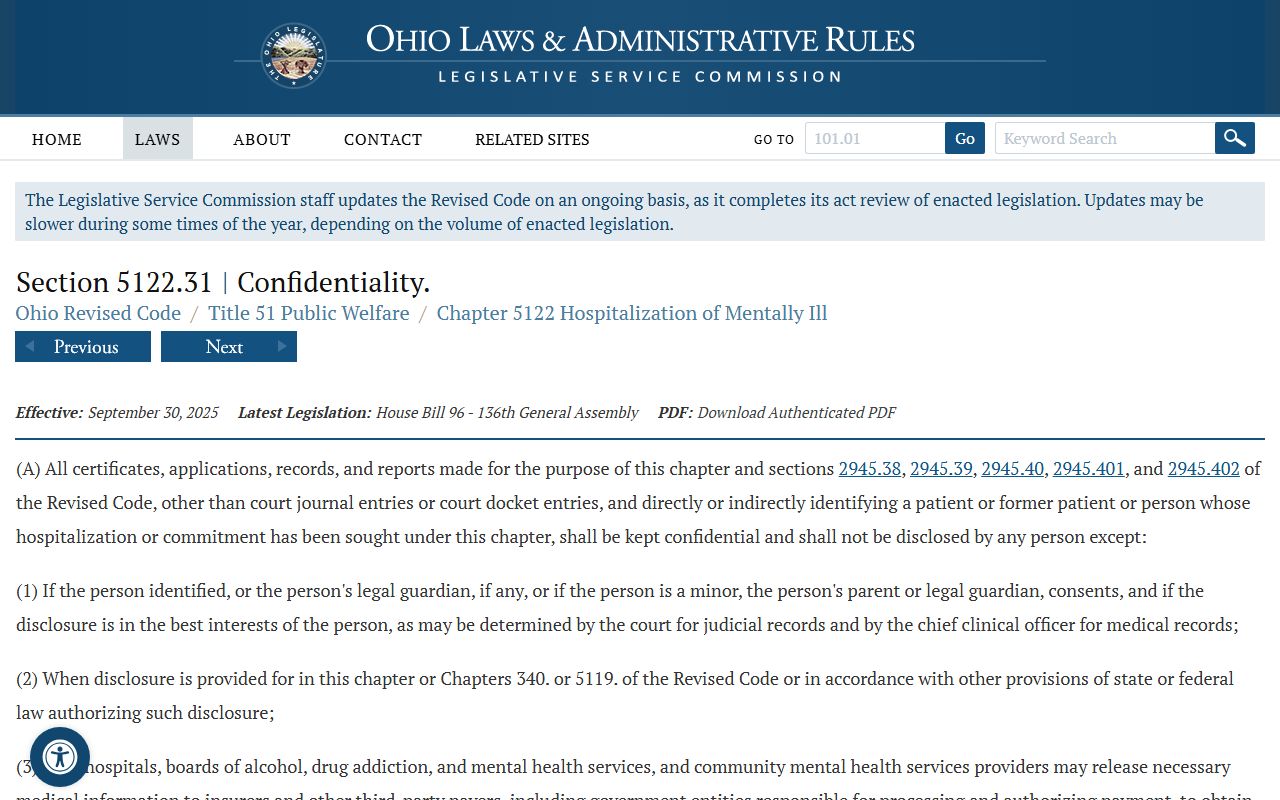
That statute matters in the warrant context because mental-health commitment proceedings can produce related court orders and warrant-type documents that stay confidential even after the proceeding is resolved. Requests for those records require a statutory basis or court order, not a standard public-records request.
Grand jury proceedings and sealed indictments are also not public. If a felony warrant stems from a sealed grand jury indictment, the warrant itself may not appear in public court records until unsealed by the court. Common Pleas staff can confirm whether a case is publicly accessible without revealing sealed content.
Attorney Help for Lucas County Warrant Issues
Warrant situations often call for legal advice, especially when arrest risk is present or when the underlying charge is serious. Ohio allows courts to appoint counsel for people who cannot afford an attorney, but court-appointed attorneys are assigned by the judge after a person appears in court. Arranging help before surrendering or before law enforcement makes contact gives you more options and more control over the process.
Three local resources are available for people in Lucas County who need legal help with a warrant or criminal matter:
- Toledo Bar Association Lawyer Referral and Information Service: 419-242-2000. Connects callers with attorneys who handle criminal and warrant matters in the Toledo area.
- Legal Aid of Western Ohio: 419-724-0460. Provides civil legal help for income-eligible residents, including some matters that stem from court orders.
- Advocates for Basic Legal Equality (ABLE): 419-255-0814. Civil rights and legal aid services for eligible Lucas County residents.
Ohio Legal Help at ohiolegalhelp.org also offers self-help information, forms, and plain-language guides for people navigating Ohio court matters without a lawyer. It covers topics like what to expect at a criminal hearing and how sealing and expungement work under ORC 2953.32.
For questions about the underlying charge in a Common Pleas case, the Lucas County Prosecutor's Office handles criminal cases at 419-213-4700. The Prosecutor does not provide legal advice to defendants, but staff can answer general questions about case status for matters already filed.