
Ohio Court of Common Pleas in Lucas County
Ohio's constitution creates one Court of Common Pleas in each of the state's 88 counties. That makes Common Pleas the only trial court expressly required by the Ohio Constitution, and it gives the court broad original jurisdiction. In Lucas County, Common Pleas is organized into four divisions: General, Domestic Relations, Juvenile, and Probate. Each division has its own judges, its own case types, and in some cases its own building or floor. All four share the common thread of being part of the same constitutional court.
The General Division is the busiest and most visible. It hears felony criminal cases, major civil actions, foreclosures, judgment liens, and tax-foreclosure proceedings. The case-number prefixes from the Clerk of Courts identify which division a case belongs to: CR, LR, and MS prefixes point to the General Division at 700 Adams Street; DR and DM prefixes go to Domestic Relations; and CL prefixes belong to the Sixth District Court of Appeals, which sits above Common Pleas. Juvenile matters use the Juvenile Court Center on Spielbusch Avenue. Knowing the prefix before you search saves time when you call the Clerk or pull up an online docket.
Ohio's Supreme Court overview of Ohio courts describes the Common Pleas system statewide. The Lucas County version is shaped by local rules, the county's size, and the volume of cases coming through Toledo's courts and surrounding municipalities.
Lucas County Courts: Addresses and Phones
Multiple courts serve Lucas County residents, from the Common Pleas divisions downtown to four municipal courts and a federal courthouse. The table below covers the main courts, addresses, and phone contacts drawn from official county and court sources. Use the division-specific phone lines when you already know what kind of case you have.
| Court | Address | Phone | Jurisdiction / Notes |
|---|---|---|---|
| Court of Common Pleas, General Division | 700 Adams Street, Toledo, OH 43604 | 419-213-4777 (admin); 419-213-4484 (case info) | Felony criminal, major civil, foreclosures, judgment liens, tax foreclosure; online dockets through Clerk/Tyler portals. |
| Clerk of Courts, Criminal Division | 3rd Floor, 700 Adams Street, Toledo, OH 43604 | 419-213-4480; file room 419-213-4483 | Custodian for felony criminal, appellate, and tax foreclosure filings. |
| Court of Common Pleas, Domestic Relations | 700 Adams Street, Toledo, OH 43604 | 419-213-6901 (dates); 419-213-6902 (copies/divorce records) | Divorce, dissolution, support, custody; separate Domestic Relations Online Dockets system. |
| Juvenile Court | Juvenile Court Center, Spielbusch Avenue, Toledo, OH 43604 | 419-213-6722 | Children under 18; delinquency, abuse, neglect, paternity, juvenile traffic; created by statute 1977. |
| Probate Court | 700 Adams Street, Suite 200, Toledo, OH 43604 | 419-213-4775; Marriage License 419-213-4361 | Estates, wills, guardianships, adoptions, civil commitments, marriage licenses. See Probate Records. |
| Ohio Sixth District Court of Appeals | One Constitution Avenue, Toledo, OH 43604 | 419-213-4755; fax 419-213-4844 | Appeals from Common Pleas, municipal, and county courts in Erie, Fulton, Huron, Lucas, Ottawa, Sandusky, Williams, and Wood counties. Hours 8:00 a.m.-4:00 p.m. |
| Toledo Municipal Court | Toledo Municipal Court system; see tmc-clerk.com | See tmc-clerk.com | City-level criminal, traffic, civil, small claims, evictions; separate case-search system. |
| Maumee Municipal Court | 400 Conant Street, Maumee, OH 43537 | 419-897-7136 | Maumee, Waterville, Whitehouse, Waterville Township, Lucas portion of Swanton, agencies south of Ohio Turnpike. |
| Sylvania Municipal Court | 6700 Monroe Street, Sylvania, OH 43560 | 419-885-8975 | Sylvania area; has active warrant list, case search, online payments, and specialized dockets. |
| Oregon Municipal Court | 5330 Seaman Road, Oregon, OH | Verify with court | Eastern Lucas County municipal matters; cited as court of jurisdiction in booking records. |
| U.S. District Court, N.D. Ohio, Toledo | Federal Building, Toledo | See ohnd.uscourts.gov | Federal criminal and civil cases for the 40 northernmost Ohio counties; records on PACER. |
The Lucas County Common Pleas FAQ explains the local court split in plain terms and confirms where each case type belongs. The county public FAQ is a good first stop when you are not sure which division handles your matter.
The main courthouse campus sits at 700 Adams Street. The building block is bounded by Adams, Erie, Jackson, and Michigan Streets in downtown Toledo. The Sixth District Court of Appeals is at One Constitution Avenue, a short distance away.
The 700 Adams Street campus holds the General Division, Domestic Relations, Probate Court, and the Clerk of Courts offices, all within the same downtown courthouse block. Parking in the area is metered street or nearby lot; confirm current rates before you come in.
Divisions of Lucas County Common Pleas
Each of the four Common Pleas divisions handles a different slice of the court docket. The General Division is the one most people mean when they say "Common Pleas." It takes felony criminal cases after indictment or information is filed, and it handles larger civil matters including foreclosures and significant money judgments. The legacy online docket used CI (civil), TF (tax foreclosure), and LN (lien) category codes for civil-side cases, along with CR and MS prefixes for criminal matters.
Domestic Relations handles divorce, dissolution of marriage, legal separation, spousal support, child support, and custody and parenting-time disputes. It uses its own docket system and its own Clerk division. Phone lines are split: call 419-213-6901 for court dates and 419-213-6902 for copies or divorce records. Personal identifiers, minor children's sensitive data, financial account numbers, and sealed filings are subject to redaction under Ohio Sup.R. 44-47 and local court rules.
Juvenile Court operates at the Juvenile Court Center on Spielbusch Avenue. It was created as a separate, distinct division by statute in 1977, reflecting Ohio's emphasis on specialized juvenile justice. The court hears delinquency, unruly, abuse, neglect, dependency, juvenile traffic, paternity, nonsupport, and visitation and custody matters that arise from juvenile or family circumstances. Juvenile records are not ordinary adult criminal records. Access is narrower, and the court's ORC 2151.14 governs who may see them and when.
Probate Court sits at Suite 200 of the main courthouse. It handles estate administration, wills, guardianships, and conservatorships, along with adoptions and mental-health civil commitments. Marriage licenses are issued through Probate's Marriage License Bureau. Adoption records are confidential under ORC 3107.17, and mental-health commitment records are protected by ORC 5122.31. Routine public probate case information is searchable through the Probate Court eAccess portal. For more on estate and will records, see the Probate Records page.
Court of Common Pleas vs. Municipal Court
Ohio's court structure draws a clear line between Common Pleas and municipal courts. Both handle cases in Lucas County, but they do not overlap much. Common Pleas sits above municipal courts in the hierarchy and takes cases that exceed municipal-court limits in case value, charge severity, or subject matter. Municipal courts serve as limited-jurisdiction trial courts for everyday misdemeanor, traffic, eviction, and smaller civil matters.
| Court of Common Pleas | Municipal Court | |
|---|---|---|
| Criminal Jurisdiction | Felony cases (all felony degrees); major criminal trials | Misdemeanors, traffic offenses, and ordinance violations; initial appearances and arraignments for felony arrests |
| Civil Jurisdiction | No statutory dollar cap; handles major civil, foreclosures, large judgments, and liens | Limited; Maumee small claims cap is $6,000 for money-only claims; larger civil caps vary by court |
| Family Cases | Yes (Domestic Relations division): divorce, dissolution, support, custody | No family-law jurisdiction; domestic matters go to Common Pleas Domestic Relations |
| Probate/Estate | Yes (Probate division): wills, estates, guardianships, adoptions | No probate jurisdiction |
| Juvenile Cases | Yes (Juvenile division): delinquency, abuse, dependency, paternity | Juvenile traffic may route through municipal court depending on issuing jurisdiction |
| Appeals From | Appealed to Ohio Sixth District Court of Appeals | Appealed to Ohio Sixth District Court of Appeals |
| Record Location | Lucas County Clerk of Courts; online via re:SearchOH and Justice Case Access | Each municipal court clerk; Toledo at tmc-clerk.com, Sylvania at sylvaniacourt.com, Maumee at maumee.org |
A person arrested for a felony may first appear in Toledo Municipal Court for a bond hearing or arraignment before the case moves to Common Pleas after grand jury indictment. That path is one reason a single person can show up in two different court systems before a case is fully resolved. For court records research, check both Common Pleas and the relevant municipal court when the record type or case stage is unclear.
How a Case Moves Through Lucas County Courts
Criminal and civil cases follow different paths, but both can end up at the Sixth District Court of Appeals and then the Supreme Court of Ohio if the losing side has grounds to appeal. The process below reflects how Ohio Common Pleas cases typically move, based on the court structure and local sources. Individual cases vary, and a judge can modify timing at each stage.
Criminal case flow:
Arrest / Booking at Lucas County Corrections Center › Municipal Court (initial appearance, bond, arraignment on misdemeanor or felony arrest) › Grand Jury Indictment (felony) › Common Pleas Arraignment › Pretrial Motions and Hearings › Plea or Trial › Sentencing › Sixth District Court of Appeals › Supreme Court of Ohio (discretionary review)
Civil case flow:
Complaint Filed (Common Pleas General Division or Municipal Court, depending on amount) › Service of Process › Answer › Discovery › Pretrial / Mediation › Trial or Summary Judgment › Final Judgment › Post-Judgment Motions › Sixth District Court of Appeals › Supreme Court of Ohio
Full Ohio appellate ladder (Lucas County):
Municipal Court or Common Pleas Trial Division › Ohio Sixth District Court of Appeals (One Constitution Ave, Toledo) › Supreme Court of Ohio (Columbus, discretionary review)
Federal cases in the Toledo area follow a separate track: U.S. District Court (N.D. Ohio, Toledo) › U.S. Court of Appeals for the Sixth Circuit › U.S. Supreme Court. Federal and state courts are entirely separate systems, and a state conviction does not produce a federal court record.
Note: Case-number prefixes tell you where in the system a matter sits. CL cases at the Clerk's office are Sixth District Court of Appeals cases; CR and MS are active or closed General Division criminal matters; DR and DM belong in Domestic Relations.
Ohio Sixth District Court of Appeals
The Sixth District Court of Appeals has its principal seat at One Constitution Avenue in Toledo and hears appeals from trial courts across eight northwest Ohio counties: Erie, Fulton, Huron, Lucas, Ottawa, Sandusky, Williams, and Wood. Lucas County is one of the highest-volume counties in the district because of Toledo's population and the number of Common Pleas and municipal-court cases it generates each year.
The court's phone is 419-213-4755, fax 419-213-4844, and regular hours are 8:00 a.m. to 4:00 p.m. The county's website page for the Sixth District is at lucascountyoh.gov, where the administrator's contact information and appeals filing information are listed. Cases at the appellate level use the CL prefix in the Clerk's filing system.
Not every case gets reviewed. The Supreme Court of Ohio has discretionary jurisdiction over most appeals, meaning it can decline to hear a case. The Sixth District, by contrast, hears most appeals of right from Common Pleas and municipal courts. An appellate decision from the Sixth District is binding in all eight counties it serves unless overturned by the Supreme Court of Ohio or a contradictory Sixth District en-banc ruling.
The Clerk of Courts page confirms that the Clerk's office is the custodian for appellate filings along with civil, criminal, and domestic records. Searches for Sixth District case information that involve Lucas County originate with the same Clerk office that handles Common Pleas filings.
Federal Courts in Lucas County
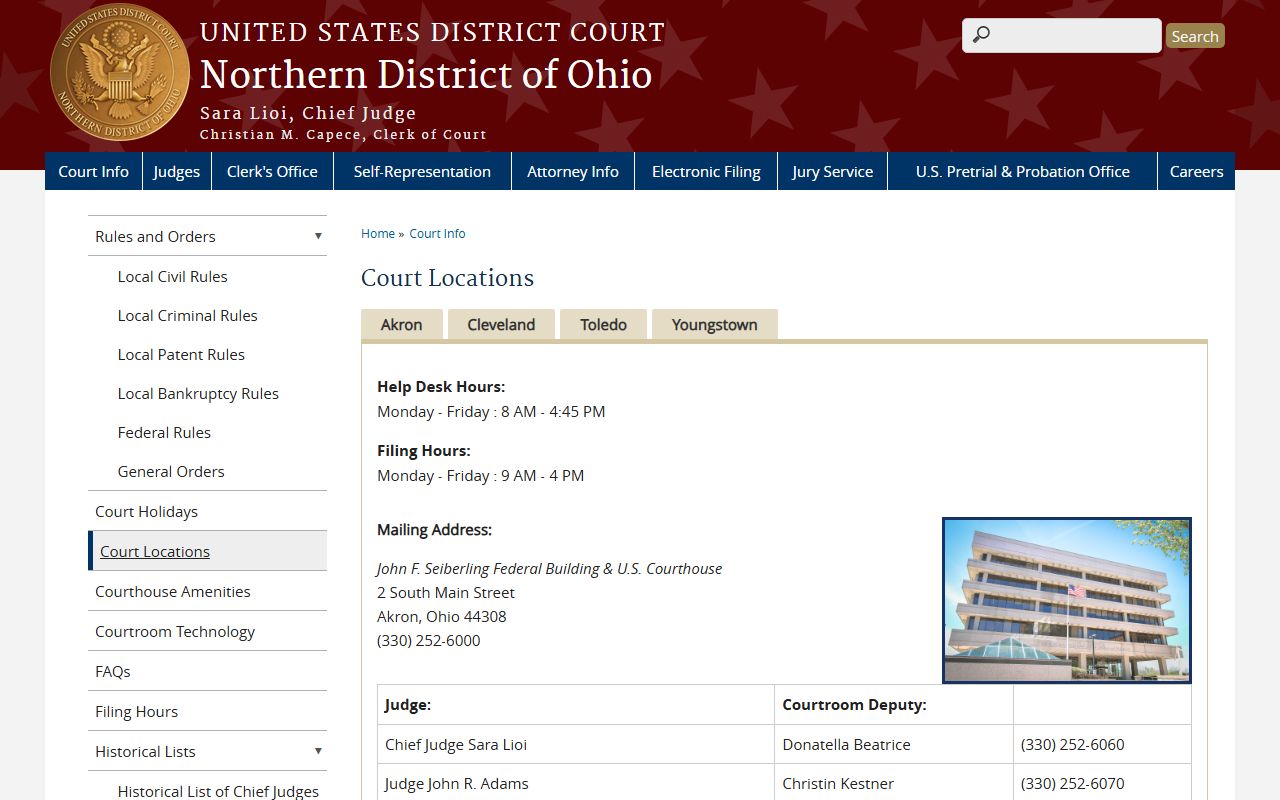
Lucas County falls within the U.S. District Court for the Northern District of Ohio. The Northern District covers the 40 northernmost counties of Ohio and holds court in Cleveland, Akron, Toledo, and Youngstown. The Toledo division serves Lucas County and the surrounding northwest Ohio area for federal criminal and civil matters, including federal crimes, civil rights litigation, diversity-jurisdiction disputes, prisoner litigation, and federal-agency cases.
The federal courthouse location page for Toledo lists the Toledo division's address and filing information. Federal court records are not part of the Lucas County Clerk's system and are not searched through re:SearchOH or Tyler portals. Federal dockets and documents are accessed through PACER, which charges per-page fees after a quarterly threshold. Free opinion and docket coverage may also be available through CourtListener when records are uploaded.
The image below is from the Northern District of Ohio Toledo courthouse page, showing the federal court's Toledo location details.
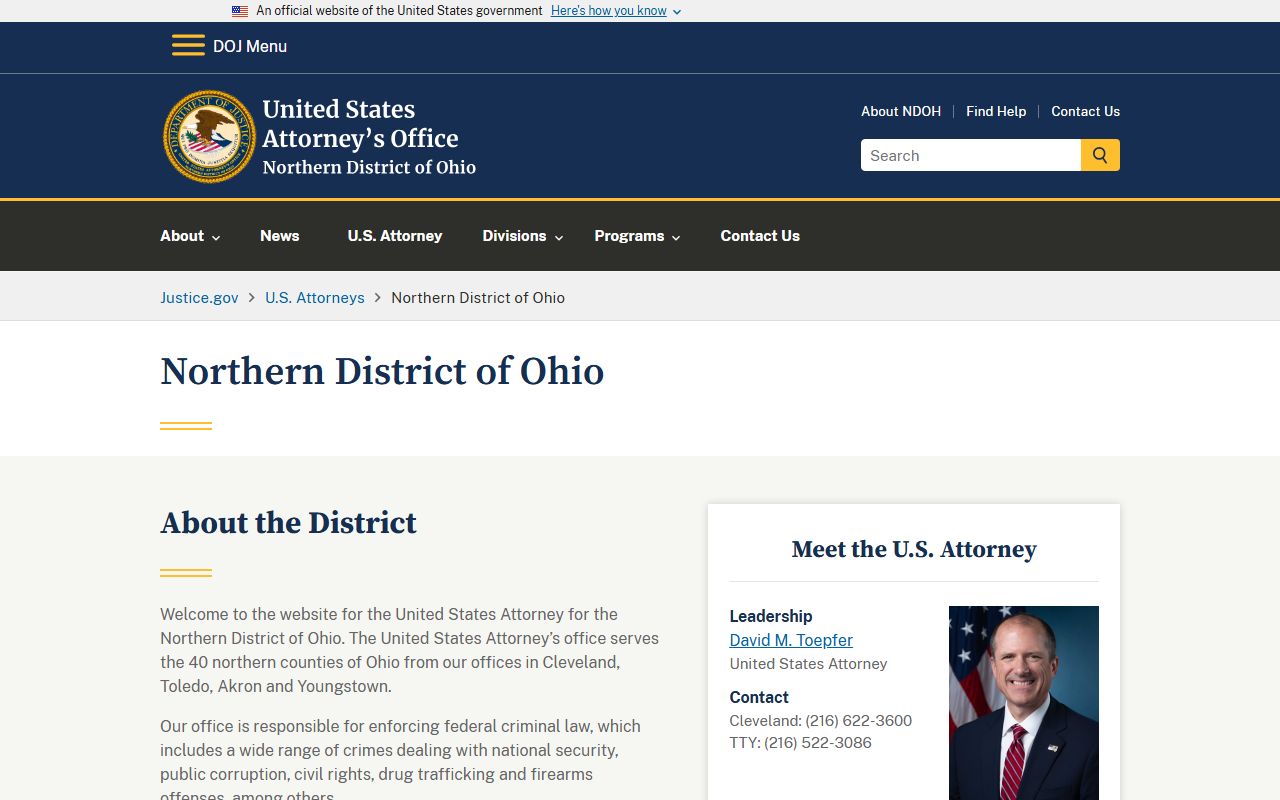
Federal criminal prosecutions in Lucas County are handled by the U.S. Attorney for the Northern District of Ohio. That office coordinates with federal law enforcement agencies including the FBI, DEA, HSI, and others. The booking summary PDF from the Lucas County Corrections Center sometimes lists "U.S. Federal Bureau of Investigation" as an arresting agency and "Federal District Court" as the court of record for some charges, showing the points at which federal and county systems can intersect before a case moves to federal court.
The U.S. Attorney's office page is captured below, showing its contact and mission for the Northern District.
Federal criminal records do not appear in Ohio state court searches. If you are looking for a federal case, PACER is the right route. Ohio's Public Records Act, ORC 149.43, applies to state and county offices, not to federal agencies; federal records follow federal court rules and PACER access policies instead.
Bankruptcy Court and Sixth Circuit
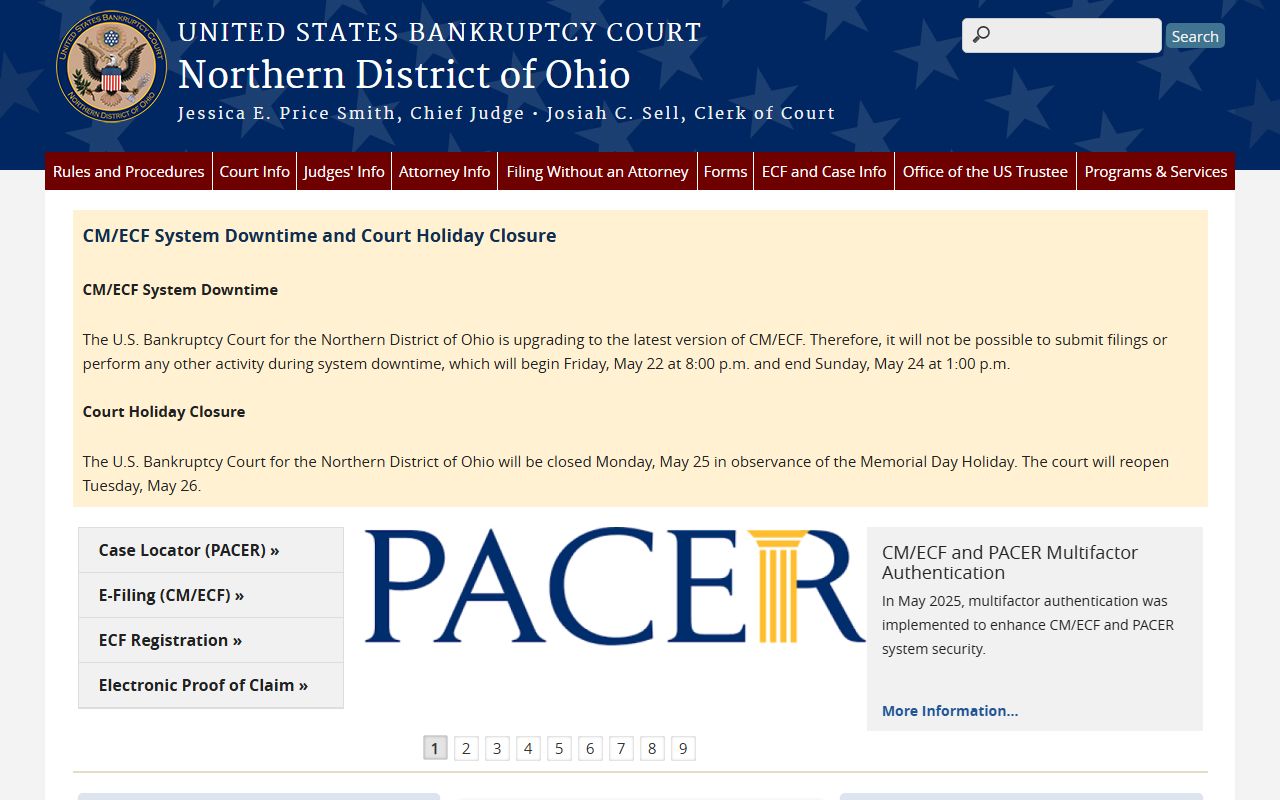
Federal bankruptcy cases for Lucas County are filed with the U.S. Bankruptcy Court for the Northern District of Ohio. The bankruptcy court is a separate unit from the district court but uses the same geographic district. It hears Chapter 7, 11, 12, and 13 bankruptcy petitions filed by individuals, businesses, and family farmers in the Northern District. Bankruptcy records are also on PACER and are not part of the Ohio Common Pleas record system.
The U.S. Bankruptcy Court, Northern District of Ohio site is pictured below.
Bankruptcy filings are public records in federal court, but they are not the same as Lucas County civil or foreclosure records at the Common Pleas level. A foreclosure filed in Common Pleas General Division is a state court matter handled by the Lucas County Clerk of Courts; a bankruptcy petition is a federal matter at the U.S. Bankruptcy Court.
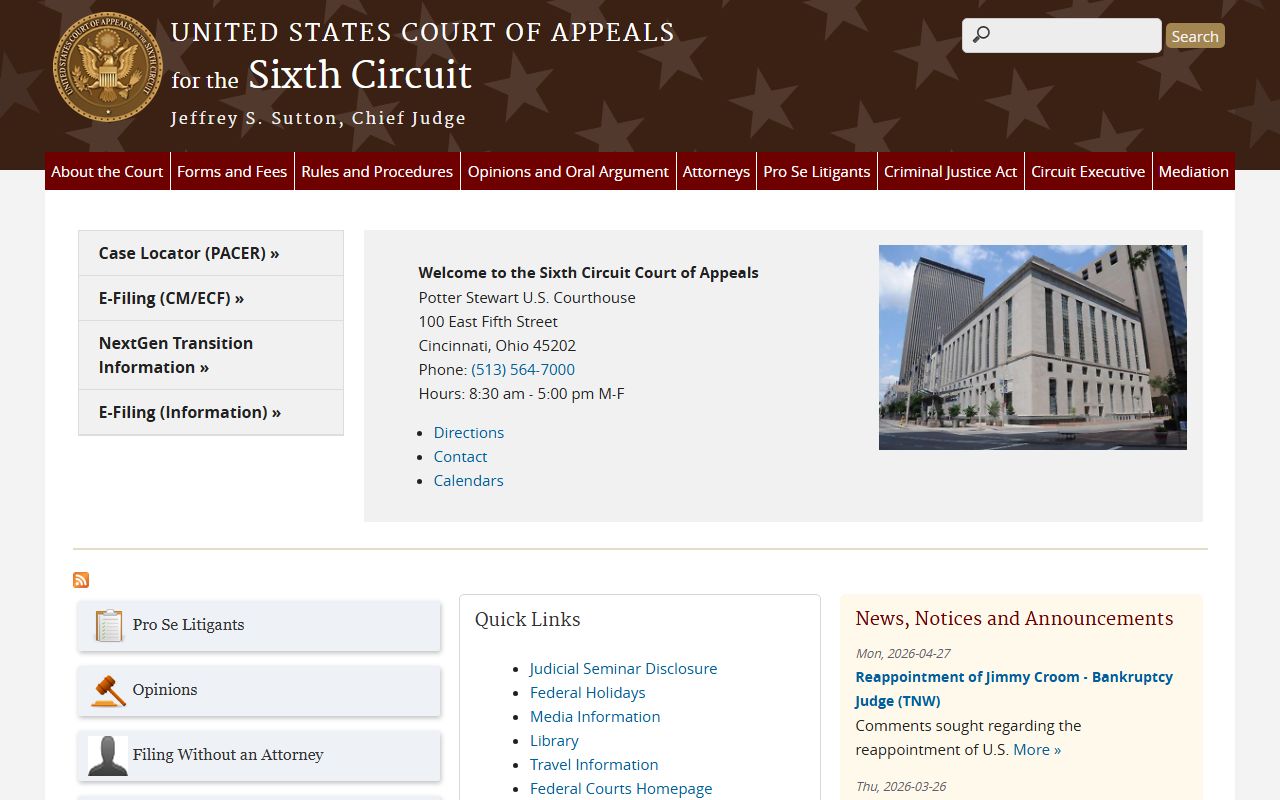
Appeals from U.S. District Court and Bankruptcy Court decisions go to the U.S. Court of Appeals for the Sixth Circuit. The Sixth Circuit covers Ohio, Michigan, Kentucky, and Tennessee and sits in Cincinnati. Its decisions bind the Northern District of Ohio unless overturned by the U.S. Supreme Court.
The image below is from the U.S. Court of Appeals for the Sixth Circuit, showing the appellate court that reviews federal decisions from the Northern District of Ohio.
The Sixth Circuit is the final word on federal law in the Northern District of Ohio absent U.S. Supreme Court review, so its opinions on search and seizure, civil rights, and criminal sentencing often shape how cases play out in Toledo and Lucas County federal courts.
Municipal Courts and Lower-Court Functions
Ohio does not use justice-of-the-peace courts in Lucas County in a modern formal sense. What fills that role in most urban Ohio counties is the municipal court, which sits below Common Pleas and handles limited-jurisdiction matters. Toledo, Maumee, Sylvania, and Oregon each operate their own municipal court for the area they serve. These courts handle misdemeanor criminal cases, traffic violations, OVI, evictions, and small civil claims, and they are the first stop for most people after a local police arrest.
Magistrates within the Common Pleas system handle specific functions as well. Ohio courts can and do assign magistrates to conduct hearings, take evidence, and issue decisions, which judges then review and adopt or modify. In busy Domestic Relations and Juvenile Court dockets, magistrates take a significant share of the workload. A decision labeled "Magistrate's Decision" in the docket is not final until the judge signs a journal entry adopting it or ruling otherwise.
- Toledo Municipal Court: largest municipal court in the county; handles Toledo city criminal, traffic, civil, and small claims; separate from Common Pleas.
- Maumee Municipal Court: serves the western and southwestern part of the county, including agencies south of the Ohio Turnpike; small claims limited to $6,000 for money-only disputes.
- Sylvania Municipal Court: serves the Sylvania area; maintains an active warrant list on its site; has specialized dockets including an SDD program.
- Oregon Municipal Court: serves the eastern part of the county; cited in booking records as the court of jurisdiction for charges arising from eastern-county police agencies.
Each municipal court runs its own case-search system. Toledo's uses tools.tmc-clerk.com for civil and criminal/traffic information. Sylvania's links to courtsvr.sylvaniacourt.com. The Maumee court directs users to its official site for case filing information. Oregon's online resources should be confirmed directly with the court. None of these municipal records appear in the Common Pleas Tyler portals or the Clerk's online docket system.
Legal Help and Self-Help Resources
Not everyone who comes to a Lucas County court has a lawyer. Common Pleas and the municipal courts see a significant number of self-represented litigants in civil, small claims, domestic, and some criminal matters. Ohio provides several free and low-cost resources to help people understand the process and fill out forms correctly before they file anything.
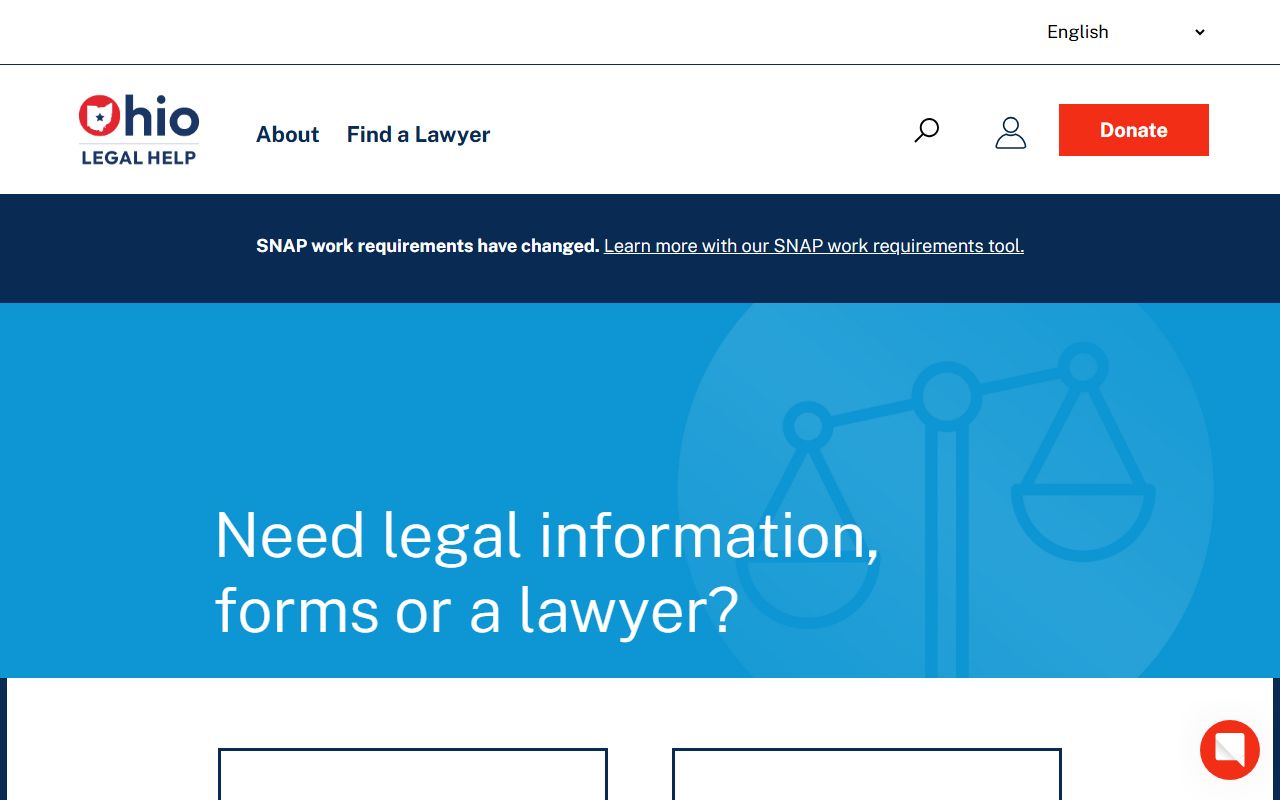
Ohio Legal Help is the statewide self-help resource for civil legal matters. It provides guided forms, plain-language explanations, and information on common court processes including divorce, eviction, protection orders, expungement, and small claims. The image below is from the Ohio Legal Help site, showing its self-help forms and resources.
Ohio Legal Help forms can be a starting point, but the Probate Court's own Jotform links are the official route for marriage license applications and copy requests. For divorce and expungement forms, the Clerk's office at 700 Adams Street has forms available, or a person can consult the Toledo Bar Association Lawyer Referral and Information Service at 419-242-2000, Legal Aid of Western Ohio at 419-724-0460, or Advocates for Basic Legal Equality at 419-255-0814.
The Clerk Criminal Division FAQ notes that for felony cases, a public defender is assigned by the judge of each court. For misdemeanor matters, Maumee Municipal Court lists its Public Defender line at 419-897-7082. Self-represented litigants in Domestic Relations or civil matters should call the Clerk's office before arriving to confirm which documents to bring and which forms are required for the type of action they plan to file.
For marriage and divorce records, the Probate Court handles marriage licenses and the Domestic Relations Clerk handles divorce. For inmate records and custody status, the Sheriff's Office and the Lucas County Corrections Center booking summary are the primary sources, not the Clerk of Courts. The Clerk of Courts page has more detail on fees, copy requests, and the records each division maintains.
Public Access to Lucas County Common Pleas Records
Ohio starts from a presumption of public access. The Ohio Public Records Act, ORC 149.43, governs records held by public offices including county administrative records. Court case documents have their own framework under the Ohio Rules of Superintendence, specifically Sup.R. 44 through 47, which presume public access to court records unless a statute, rule, or court order restricts them. The Clerk's 2025 public-records policy cites ORC 149.43 directly and says exemptions are construed narrowly.
You do not need to give your name, submit a written request, or explain why you want a record. The request only needs to reasonably identify what you are looking for. If the Clerk asks for contact information, the office must first tell you that providing it is optional. Paper copies from the Clerk's public-records process run $0.05 per page under the 2025 policy. Criminal Division case copies are listed at $0.10 per page in the Clerk's Criminal FAQ, a different rate. Email delivery is free when the office can produce the file that way. The Clerk's full public-records policy is posted on the county site.
Not all records are open. Juvenile delinquency and abuse files are restricted under ORC 2151.14. Adoption records are confidential under ORC 3107.17. Mental-health commitment records are protected by ORC 5122.31. Sealed criminal records under ORC 2953.32 are removed from ordinary public view after a court order. Social Security numbers, financial account numbers, and certain other personal identifiers are redacted under Sup.R. 44-47. A record showing as searchable online does not mean every document image can be downloaded; some materials require an account, an in-person visit, or a formal copy request.
For court dockets and case lookup, start at the Clerk's Online Dockets page for current portal links. General Division cases moved to Tyler re:SearchOH and Justice Case Access as of January 6, 2026. See court records for a full walkthrough of the search process and the available search fields.
Note: Ohio's Public Records Act covers county administrative records; court case documents also fall under the Ohio Rules of Superintendence, so both frameworks may apply to the same request depending on record type.