
What Lucas County Probate Court Handles
The Lucas County Probate Court is a division of the Court of Common Pleas, seated in downtown Toledo at 700 Adams Street, Suite 200. It is the only court in the county with authority over probate matters, and its jurisdiction covers a wide range of civil proceedings that touch on death, incapacity, family status, and marriage. The court does not handle criminal cases or civil lawsuits between private parties over money or contracts; those go to other Common Pleas divisions or the municipal courts.
Probate Court handles six broad categories of matters. Estates and wills are the most well-known, but the court also takes guardianship petitions when a person cannot care for themselves, adoption proceedings, mental-health civil commitments under Ohio law, and marriage license applications. Each category produces its own case file. Estate cases can run months or longer when real property, creditor disputes, or missing heirs are involved. Guardianship matters require ongoing reporting to the court even after the initial appointment. Marriage license applications are typically resolved in a single visit, though copy requests afterward take about three weeks to fulfill by mail.
The probate caseload matters to anyone searching court records because probate files are a distinct record stream. They are not in the Clerk of Courts system used for felony and civil cases. They are not in the Toledo Municipal Court or Domestic Relations dockets. Probate Court maintains its own portal, its own forms, and its own office contact numbers.
Probate Terms Defined
Probate filings use legal terms that are not always clear to people searching records for the first time. The list below covers the words that appear most often in Lucas County Probate Court case files. Understanding them helps you read a case docket and know what stage the estate or guardianship has reached.
- Testator
- The person who made a will. When someone dies and a will is filed with Probate Court, that person is called the testator. The will names who gets the estate and who is in charge of settling it.
- Executor
- The person named in the will to carry out its terms. The executor gathers assets, pays debts and taxes, files required inventories with the court, and distributes what remains to the named beneficiaries. Ohio law may also call this person a fiduciary or personal representative.
- Administrator
- When someone dies without a will, the court appoints an administrator instead of an executor to settle the estate. The administrator has the same basic duties but works under Ohio intestacy law rather than a will.
- Intestate
- Dying without a valid will. Ohio law then controls how assets pass to heirs, starting with the surviving spouse and children. The word appears often in estate case descriptions on the probate docket.
- Guardianship
- A court arrangement where one person is given legal authority to make decisions for another who cannot care for themselves due to age, disability, or incapacity. Lucas County Probate Court appoints guardians and requires regular reporting on the ward's condition and finances.
- Conservatorship
- Similar to guardianship but focused on managing property and finances rather than personal care. A conservator handles money and assets for a person who cannot do so safely on their own.
These terms will appear in case type fields, docket entries, and court notices when you search Probate eAccess or request a file copy. If a docket entry uses a word you do not recognize, the Probate Court clerk can explain it, though staff cannot give legal advice on what the entry means for your rights.
How to Search Lucas County Probate Records Online
The Lucas County Probate Court provides public case access through Probate eAccess, a web portal separate from the Clerk of Courts systems used for felony and civil cases. Most estate, guardianship, and marriage license cases that are public records can be looked up there by name or case number. Adoption files and mental-health civil commitment records are not available through the public portal because state law restricts those case types. Do not expect eAccess to return results for those matters.
The search form in eAccess uses five fields. The table below lists each one so you know what to prepare before you start.
| Field Label | Type | Required | Notes / Format |
|---|---|---|---|
| Name | Text | No | Search by party or applicant name; useful when no case number is known. |
| Case Number | Text | No | Case-specific lookup; fastest path when you have the number. |
| Case Type | Dropdown | No | Marriage license and probate case types reported; full option list is dynamic and displayed in the portal. |
| Date of Birth | Date / Text | No | Used primarily in marriage-license searching to narrow results. |
| Party Type | Dropdown | No | Applicant or party role in the case; narrows large name searches. |
If eAccess does not return the file you need, contact the court directly. Some older records and certain restricted file types require an in-person visit or a formal records request. The court's main phone is 419-213-4775.
- Open Probate eAccess (linked above) in your browser.
- Enter a name, case number, or case type. You do not need to fill all fields; one search term is enough to start.
- If searching for a marriage record, adding a date of birth can help narrow results when the name is common.
- Review the case list returned and click the matching case to see the docket entries and case details.
- For documents not shown online, contact the Probate Court office or use the official forms to request copies.
Note: Marriage license cases also appear in Probate eAccess. If you need a certified copy of a marriage certificate rather than just the case record, use the court's online copy request forms described below in the marriage section, not eAccess alone.
Lucas County Probate Court Contact and Location
There is one Probate Court for Lucas County. It is housed in the main courthouse complex in downtown Toledo, accessible from Adams Street. The court shares the building address with the Clerk of Courts and the Common Pleas General Division, but it operates as a separate office with its own phone lines and email. Walk-in hours and phone customer-service hours are slightly different, so call ahead if you plan to arrive near the end of the day.
Lucas County Probate Court
700 Adams Street, Suite 200
Toledo, OH 43604
419-213-4775
Email: info@lucasprobate.org
Monday-Friday, 8:30 a.m. to 4:30 p.m.
Marriage License Bureau
700 Adams Street (Probate Court)
Toledo, OH 43604
419-213-4361
Phone service: 8:30 a.m. to 4:00 p.m.
Phones off 11:30 a.m. to 1:30 p.m. for lunch
The Marriage License Bureau is part of Probate Court and uses the same physical address. Its phone line is separate from the main court number. If you are calling about a marriage license or a copy of a marriage certificate, use 419-213-4361. For all other probate matters, call 419-213-4775 or email info@lucasprobate.org.
How the Probate Process Works in Lucas County
An estate case typically begins within a few weeks after someone dies. The first step is filing the will with Probate Court, if one exists, along with an application to administer the estate. The court reviews the filing and appoints a fiduciary, which may be the executor named in the will or an administrator chosen by the court when no will exists. That person then takes on the legal duties of gathering and safeguarding assets, notifying creditors, and filing an inventory with the court.
Once the court appoints a fiduciary, the estate moves through a series of required filings. An inventory of assets goes to the court early in the process. Creditors get notice and time to file claims. The fiduciary pays valid debts and files accounts showing what came in and what went out. After the court accepts the final account, distribution to heirs or beneficiaries can proceed. Routine estates with clear titles, few debts, and willing heirs often wrap up in a few months. Contested estates, those with disputed wills, real estate that must be sold, missing heirs, or ongoing creditor disputes, can run much longer.
Guardianship cases follow a different path. A petition is filed with the court, notice goes to the proposed ward and close family members, and a hearing is held. If the court finds the person cannot manage their own affairs, it appoints a guardian. Unlike an estate that closes after distribution, a guardianship can stay open for years. The guardian must file regular reports on the ward's condition and finances, and the court reviews those to make sure the ward is protected.
Adoption and mental-health civil commitment proceedings also go through Probate Court, but those files are not public. State law closes them to routine inspection. If you have a legal need to access those records, consult an attorney about the proper court process for gaining access.
Lucas County Probate Court Fees and Forms
The Probate Court posts its current fee schedule and estate or guardianship form list on its official forms page. Because fee schedules can change with court rule amendments or state law updates, the table below points you to the source rather than repeating specific dollar amounts that may be outdated by the time you read them.
| Item | Where to Find Current Amount |
|---|---|
| Estate filing fees (will, application to administer, letters) | Current fee schedule posted at lucasprobate.org/forms |
| Guardianship application fees | Current fee schedule posted at lucasprobate.org/forms (see link above) |
| Certified copy of estate documents | Contact Probate Court at 419-213-4775 or see forms page |
| Online marriage license | $63.54, debit or credit card only |
| In-person marriage license | $60.00, cash or credit card (convenience fee applies) |
| Court wedding fee | $50.00, cash only |
Marriage license fees are confirmed on the official Probate Court marriage page and are listed here because they are stable published amounts. Estate and guardianship fees require a check of the current schedule before filing. The forms page at lucasprobate.org is also where you will find the approved forms for estate inventory, accountings, and guardianship reports. Using the wrong form version can slow your case.
What Lucas County Probate Records Contain
A probate case file is not a single document. It is a growing collection of filings that tracks every step from the first petition through final distribution or closure. The exact contents depend on the case type, but most estate files share a common set of documents.
A typical estate file includes the original will or a statement that none exists, the application to administer, the court's order appointing a fiduciary, an inventory listing assets and their estimated values, one or more accounts showing income and disbursements, creditor notices and claim records, and the final order approving distribution. Large or complicated estates may also include real estate appraisals, sale orders, court approvals for unusual transactions, and records of any disputes heard by the probate judge.
- Will or intestacy determination
- Application and letters of authority (testamentary or of administration)
- Inventory of estate assets
- Creditor notice and claim records
- Estate accounts and disbursements
- Final distribution order
- Guardianship reports and court review orders (for open guardianships)
Guardianship files contain the petition, medical or psychological evaluations supporting the incapacity finding, the court's appointment order, and periodic guardian reports. Marriage license files show applicant information and the license itself. Certified copies of marriage certificates are the document most often requested from those files, and they must be ordered through the court's copy-request forms rather than printed from eAccess.
Restricted Probate Records in Lucas County
Two categories of Probate Court cases are confidential under Ohio law and are not visible in eAccess or available through ordinary public records requests. Adoption records are sealed under ORC 3107.17, which makes adoption hearings and records confidential except as state law expressly permits. Mental-health civil commitment records are restricted under ORC 5122.31, which protects psychiatric hospitalization and treatment information from public disclosure.
These restrictions apply even though Probate Court handles both types of proceedings. The court's eAccess portal is not a route to adoption files or mental-health commitment records. Do not expect to find them there. If you have a legal right to access a restricted file, that right comes from a specific statute or court order, not from a general public-records request. An attorney can explain the statutory access paths that may apply in your situation.
Note: Personal identifiers such as Social Security numbers and financial account numbers are redacted from public probate files under Ohio Rules of Superintendence 44 through 47, even in cases that are otherwise open.
Beyond adoptions and mental-health cases, some estate documents may be restricted by court order, especially in contested cases involving minors, domestic violence concerns, or sealed settlement terms. If a case shows on the docket but the documents are not viewable, contact the court to learn whether a restriction order is in place and what access, if any, is permitted.
Marriage Records Through Lucas County Probate Court
Marriage licenses in Lucas County are Probate Court records, not Clerk of Courts records. The Marriage License Bureau inside Probate Court issues new licenses and holds the official record once a license is filed and returned after a ceremony. If you need a certified copy of a marriage certificate or a marriage abstract, the request goes to Probate Court, not to the Clerk of Courts Domestic Relations Division. Divorce records, by contrast, belong to the Clerk's Domestic Relations Division. The two offices are separate, and the records do not overlap.
Copy requests for marriage records go through official online forms rather than a walk-in counter pickup. Certified copies are mailed to the address you provide and cannot be emailed or faxed. Allow about three weeks. Probate Court offers three request paths: a certified copy of the marriage certificate, a marriage abstract, and an affidavit of search when you need written confirmation of whether a record exists. For full details on fees, application requirements, and prior-marriage documentation rules, see the marriage and divorce records page.
Related Lucas County Offices and Records
Probate Court handles civil commitments for mental-health matters, which is one point where the court's work intersects with other county agencies. The Lucas County Sheriff's Office runs the corrections and detention operations downtown, separate from the Probate Court's civil jurisdiction. The Lucas County Prosecutor's Office handles criminal matters that may arise from related investigations, also distinct from probate proceedings. The images below show several of these offices and resources to help you understand how they fit into the broader county system.
The Lucas County Prosecutor's Office, led by Julia R. Bates, handles criminal prosecution and a range of civil legal functions for the county, including cases that may overlap with probate matters when financial crimes or elder abuse are alleged.
The Prosecutor's office is at 700 Adams Street, Suite 250, sharing the courthouse campus with Probate Court but serving a completely different legal function.
The Lucas County Corrections Center, operated by the Sheriff's Office, is a nine-level adult detention facility at 1622 Spielbusch Avenue, with a recommended capacity of 403 inmates and an average of about 15,430 bookings per year.
Individuals who are subject to mental-health civil commitment proceedings through Probate Court may at times have a prior or concurrent contact with the Corrections Center, but the two systems operate independently under different legal authority.
Inmate services and visitation at the Corrections Center are managed separately from any court proceedings. The inmate services page covers visitation scheduling, visitor warrant checks, dress rules, and related procedures.
Visits at the Corrections Center are non-contact video only, by appointment Tuesday through Saturday, and subject to a full warrant check on every visitor.
When you need records from the Sheriff rather than the court, the Sheriff's public records request page is the route for police reports, accident records, and video footage.
Sheriff records are governed by the Ohio Public Records Act, with paper copies free for the first ten pages and $0.10 per page after that. Dash and body camera footage requests cost $75 per hour of video produced, with a written estimate provided before production begins.
The Lucas County Sheriff sex offender registry page provides local contact information and explains Ohio's three-tier registration system.
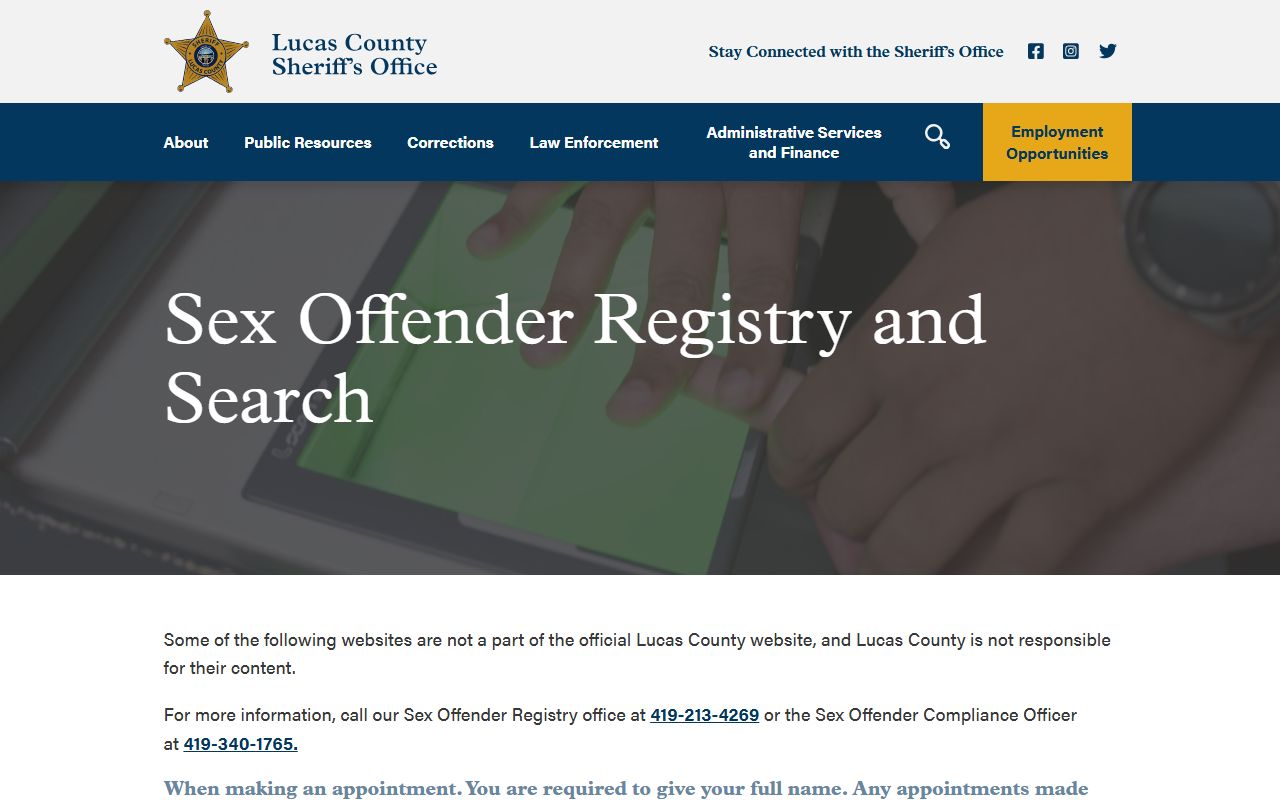
Tier I offenders register once a year for 15 years; Tier II every six months for 25 years; Tier III every 90 days for life, with community notification for Tier III moves near certain entities. The sex offender registry is a Sheriff function under ORC 2950.13 and is entirely separate from Probate Court records.