
How to Search Lucas County Court Records
Most searches start at the Lucas County Clerk of Courts Online Dockets page. The Clerk lists the current portal links there and updates them as systems change. As of a January 6, 2026 notice, General Trial Division case information moved to two Tyler Technologies products. The first is re:SearchOH, which searches across many Ohio counties. The second is Justice Case Access, which shows more Lucas General Division detail, including financial data and party addresses. Both ask for a free account, and the same login works for each.
Gather what you know before you start. A case number is fastest. A full name, a date range, and the correct court also help a lot. Divorce and support cases use a separate Domestic Relations docket. Felony and large civil cases live in the General Division. Misdemeanor and traffic cases stay with the city court that issued them. More search detail sits on the Lucas County court records page.
- Open the Clerk's Online Dockets page and read the current portal notice.
- Pick the right system. Use re:SearchOH or Justice Case Access for General Division cases, and the Domestic Relations docket for divorce and support.
- Create a free account if the Tyler portal asks for one. The same login works across re:SearchOH and Justice Case Access.
- Search by case number when you have it, or switch to a name, business name, or date-range search.
- Open the matching case to read its docket, then request a certified copy from the Clerk if you need one.
The Clerk's main office page spells out the office's role and links the dockets, eFiling, and payment tools. The page header, contact block, and quick links give a quick map of where each tool lives.
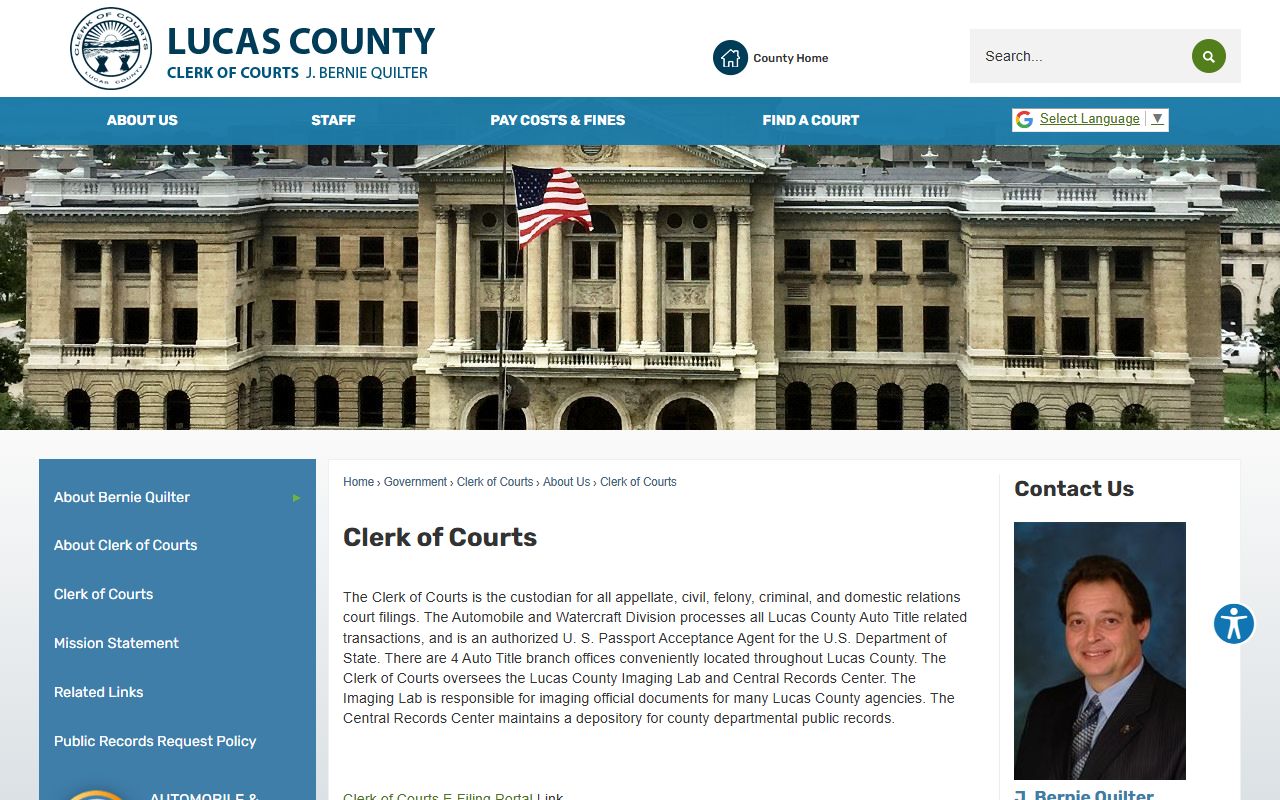
The Clerk of Courts is the custodian for appellate, civil, felony, and domestic relations filings, so this page is the right first stop for most case searches.
The Clerk's Online Dockets page is where the live portal links sit, including the 2026 notice about the move to Tyler systems.
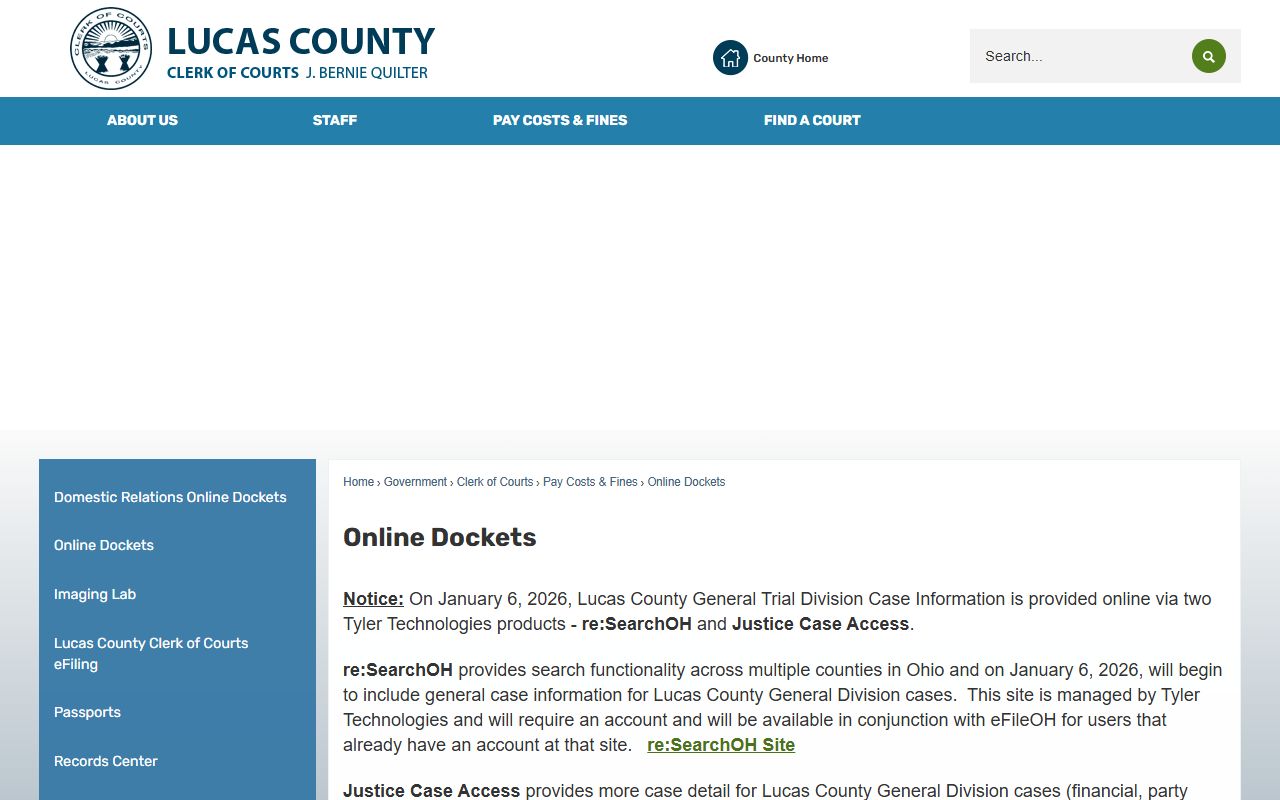
It points to re:SearchOH, Justice Case Access, the legacy General Division docket, the criminal docket calendar, and the Domestic Relations docket in one place.
The Lucas County Judicial System
Ohio runs a layered court system, and Lucas County fits into it at the trial level. The Court of Common Pleas is the main county trial court and the only trial court named in the Ohio Constitution. It splits into a General Division for felonies and major civil cases, plus separate divisions for domestic relations, juvenile, and probate matters. Below it sit the municipal courts, which take misdemeanors, traffic, evictions, and small claims within city limits. Above it sits the Sixth District Court of Appeals, with the Supreme Court of Ohio at the top.
Lucas County belongs to Ohio's Sixth District Court of Appeals, headquartered at One Constitution Avenue in Toledo. The Sixth District hears appeals from Common Pleas, county, and municipal courts across eight counties: Erie, Fulton, Huron, Lucas, Ottawa, Sandusky, Williams, and Wood. A felony case may start in municipal court for a first appearance and then move to Common Pleas after indictment.
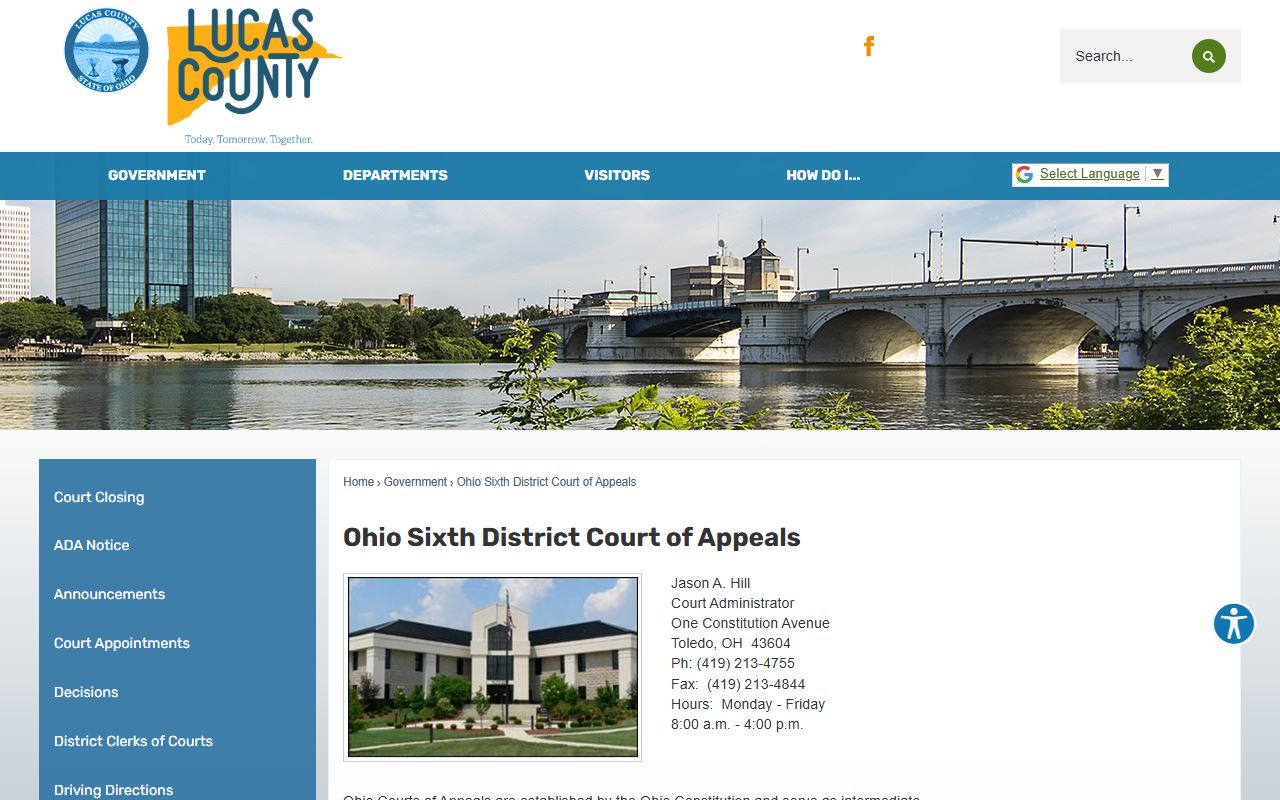
The appeals court page lists its jurisdiction, the eight counties it covers, its Toledo address, and hours, which helps if your case reaches the appellate stage.
Case flow: Municipal Court › Court of Common Pleas › Sixth District Court of Appeals › Supreme Court of Ohio
| Court | Jurisdiction | Case Types |
|---|---|---|
| Court of Common Pleas, General Division | County trial court | Felony criminal, major civil, foreclosures, tax foreclosure, liens |
| Domestic Relations Division | County trial court | Divorce, dissolution, support, custody |
| Juvenile Court | County trial court | Delinquency, abuse and neglect, paternity, juvenile traffic |
| Probate Court | County trial court | Estates, wills, guardianships, adoptions, marriage licenses |
| Municipal Courts | City limited jurisdiction | Misdemeanors, traffic, evictions, small claims |
| Sixth District Court of Appeals | Appellate, eight counties | Appeals, original writs such as mandamus and habeas corpus |
The county's Juvenile Court page explains that Lucas County set up a separate, distinct Juvenile Division by statute in 1977 to focus on cases involving children. That split is why juvenile matters do not show up in adult case portals.
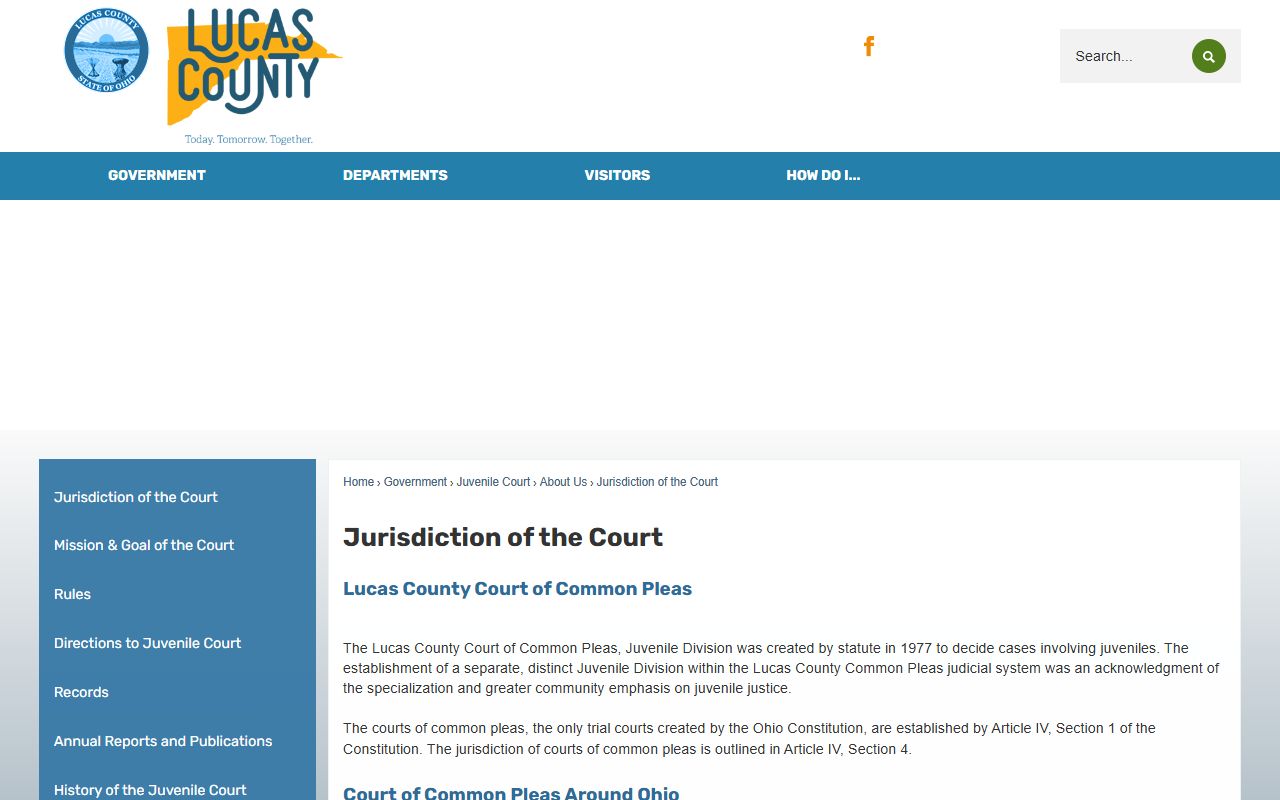
The page lays out which matters the Juvenile Division decides, from delinquency and traffic to abuse, neglect, paternity, and several related adult matters.
Common Pleas vs Municipal Court
People often mix up the two main trial levels in Lucas County. The Court of Common Pleas handles felonies and the larger civil and family caseload. Municipal courts handle the high-volume local work: traffic tickets, misdemeanors, evictions, and small money claims. Knowing the split tells you which docket to search and which clerk to call. The county's Common Pleas FAQ walks through the divisions in plain terms.
The FAQ breaks down General Division, Domestic Relations, Juvenile, and Probate work, which helps you match a case prefix to the right court.
| Point | Court of Common Pleas | Municipal Court |
|---|---|---|
| Criminal reach | Felony cases | Misdemeanors and ordinance offenses |
| Civil reach | Major civil, foreclosures, liens | Small claims and limited civil suits |
| Traffic | Not the main traffic court | Most adult traffic, including OVI |
| Search portal | re:SearchOH and Justice Case Access | City court case systems |
| Where it sits | 700 Adams Street, Toledo | Toledo, Maumee, Sylvania, Oregon |
The municipal courts each run their own case system. Toledo uses the Toledo Municipal Court case information site. Maumee serves the Maumee area and caps small claims at $6,000. Sylvania posts search records, an active warrant list, and bond pages on the Sylvania Municipal Court site. Oregon Municipal Court covers eastern Lucas County matters.
Types of Court Records Available in Lucas County
Lucas County records sort into groups by the court that creates them. The General Division produces felony and major civil files, including foreclosures, tax foreclosures, and judgment liens. Domestic Relations holds divorce and support files. Probate keeps estate, guardianship, and marriage records. Municipal courts hold the bulk of traffic and misdemeanor cases. Juvenile matters stay with the Juvenile Court and are not open like adult cases.
Each court keeps its own paper trail. Pick the type first, then the portal or office follows.
- Criminal records - felony cases in Common Pleas; misdemeanor and ordinance cases in the city courts.
- Civil records - complaints, foreclosures, liens, motions, orders, and judgments.
- Family and divorce records - divorce, dissolution, support, and custody filings in Domestic Relations.
- Probate records - estates, wills, guardianships, and marriage licenses.
- Traffic records - OVI, suspension, and moving violations in the issuing city's court.
For deeper detail on any of these, see the court records, court dockets, and arrest records pages.
What Lucas County Court Records Show
A Lucas County court record is built from docket entries and journal entries the Clerk keeps under Ohio law. Online dockets show case events as they get entered. Full filed documents may need a portal account, a copy request, or an in-person visit. The county uses prefixes to flag the right court: CR, LR, or MS for Common Pleas; DR or DM for domestic cases; CL for the Sixth District. The table below lists the common fields a case shows.
| Field | What It Shows |
|---|---|
| Case Number | A prefix or category code plus a filing number that points to the right court. |
| Filing Date | When the case was filed; used to filter date-range searches. |
| Parties | Plaintiff and defendant, or petitioner and respondent, plus business names. |
| Charges / Cause | The charge in a criminal case or the cause of action in a civil case. |
| Disposition | The outcome of a charge or case once decided. |
| Sentence / Judgment | The penalty or money award, plus costs, restitution, and bond. |
The Domestic Relations terms warn that entries can show online before a proposed action is signed and journalized. Treat the docket as a tracking tool. The official action is the signed, journalized entry, not the early online note.
Public Access Laws for Lucas County Court Records
Ohio starts from open access. The state Public Records Act covers records held by county offices like the Clerk and Sheriff, while court case documents fall under the Ohio Rules of Superintendence. The Clerk's public records policy cites the statute directly and says exemptions are read narrowly. You do not have to give your name, write the request down, or state why you want a record. The request only has to reasonably identify what you seek.
The policy lists request standards, redaction rules, and a copy-fee schedule, which is why it is worth reading before you file a request.
Key Statutes:
Ohio Revised Code § 149.43 - the Public Records Act; sets access rights, copies at cost, and prompt inspection for county office records.
Ohio Revised Code § 2953.32 - governs sealing and expungement of conviction records and deletion of index references.
Ohio Revised Code § 2151.14 - sets the special access rules that protect juvenile court records.
Ohio Revised Code § 3107.17 - keeps adoption hearings and adoption records confidential except as the law allows.
Ohio Revised Code § 5122.31 - restricts mental-health and civil-commitment records handled in Probate Court.
The Ohio Rules of Superintendence, mainly Sup.R. 44 through 47, presume public access to court records and set the process to restrict a file. For administrative records, use the term Ohio Public Records Act or Sunshine Laws, not FOIA, since FOIA applies to federal agencies. More on this sits on the public records page.
Records That Are Restricted or Confidential
Some Lucas County records are closed by law or court order. Juvenile delinquency and abuse cases, adoption files, and mental-health civil commitments are restricted. Sealed or expunged criminal cases drop out of ordinary public view under ORC 2953.32, though some government users keep access in set cases. Personal identifiers like Social Security and financial account numbers are redacted under the court rules. Grand jury matters and protected victim addresses also stay closed.
Removing a public court record is not a casual request. Under Sup.R. 47, a party must use a court-controlled process. A clerk cannot simply delete docket information because someone asks. To view a sealed file, you generally need a statute, a rule, or a court order that allows it. To seal a record, you file in the sentencing court, the prosecutor may object, and the judge decides.
Note: A docket being searchable online does not mean every filed document image can be downloaded, since some records need a portal account or a formal request.
Specialty Courts in Lucas County
Lucas County and its municipal courts run several problem-solving programs that handle cases outside the standard track. These dockets focus on treatment, supervision, and reducing repeat offenses rather than just punishment. They tend to involve closer court contact, phases, and graduation requirements. Records from these dockets follow the same access rules as the court that runs them.
Sylvania Municipal Court lists a Specialized Dockets menu with a program description and a participant handbook on its official site. The Lucas County Corrections Center also offers in-custody counseling, drug and alcohol treatment, and other reentry programming through the Sheriff. The Lucas County Prosecutor's office runs related justice programs, including a Domestic Violence High Risk Team, a Cold Case Unit, and a Conviction Integrity Unit, detailed on the Prosecutor's about page.
Lucas County Sheriff and Jail
The Lucas County Sheriff's Office, led by Sheriff Michael J. Navarre, runs the Lucas County Corrections Center at 1622 Spielbusch Avenue in downtown Toledo. The center opened in 1977. It is a nine-level facility with six housing floors and a recommended capacity of 403 inmates, and the Sheriff describes it as mostly a pretrial jail. The booking area averages about 15,430 inmates a year and posts a Booking Summary that updates every four to six hours.
To find who is in custody, use the Sheriff's site and its Booking Summary, which lists name, charges, court, arresting agency, and current status. Full roster detail sits on the Lucas County inmate records page, with released inmate and jail population data on their own pages. For active warrants, see the warrant records page, since the county has no single countywide warrant search.
Marriage, Divorce, and Probate Records
Marriage and probate records run through the Lucas County Probate Court, not the Clerk of Courts. The Probate Court keeps estates, wills, guardianships, adoptions, and marriage licenses, and its eAccess portal handles public case search. Divorce records, on the other hand, sit with the Clerk's Domestic Relations Division. The Records Center page points marriage requests to Probate and divorce requests to Domestic Relations.
The Records Center stores more than 47,000 boxes and 26,000 rolls of microfilm for county offices, but it does not take public requests directly, so contact the office that made the record.
See the marriage and divorce records and probate records pages for full steps and fees. A few common probate terms help when reading these files.
- Testator
- A person who makes a will to direct how their property passes after death.
- Executor
- The person named in a will to manage and settle the estate.
- Conservator
- A person a court appoints to manage the affairs of someone unable to do so.
Lucas County Court Records Fees
Copy fees in Lucas County are not the same across every office. The Clerk's public-records policy and its Criminal Division use different rates, and the Sheriff and Probate Court set their own. Tie each fee to the office that holds the record you want. The table below pulls the published amounts together.
| Item | Amount |
|---|---|
| Clerk public-records paper copy | $0.05 per page |
| Clerk email delivery | No charge |
| Criminal Division case copies | $0.10 per page |
| Sheriff paper records | First 10 pages free, then $0.10 per page |
| Sheriff dash or body camera video | $75 per hour of video produced |
| Online marriage license | $63.54, debit or credit card only |
The Clerk's Criminal Division FAQ explains case prefixes, copies, and bond types in more depth. It is a useful read before you order copies or post bond.
The page lists how to reach the Journal Clerk, what copies cost, and the bond types the court accepts, all of which affect your records request.
How to Interpret Lucas County Court Records
Reading a docket takes a little practice. The case number prefix tells you the court and case type. Domestic Relations legacy searches also use category codes such as CI, TF, LN, DR, DM, DU, and DS, plus a ten-digit number and a three-digit extension. Knowing the code saves you from searching the wrong system. The Domestic Relations online docket shows these search fields once you accept the terms.
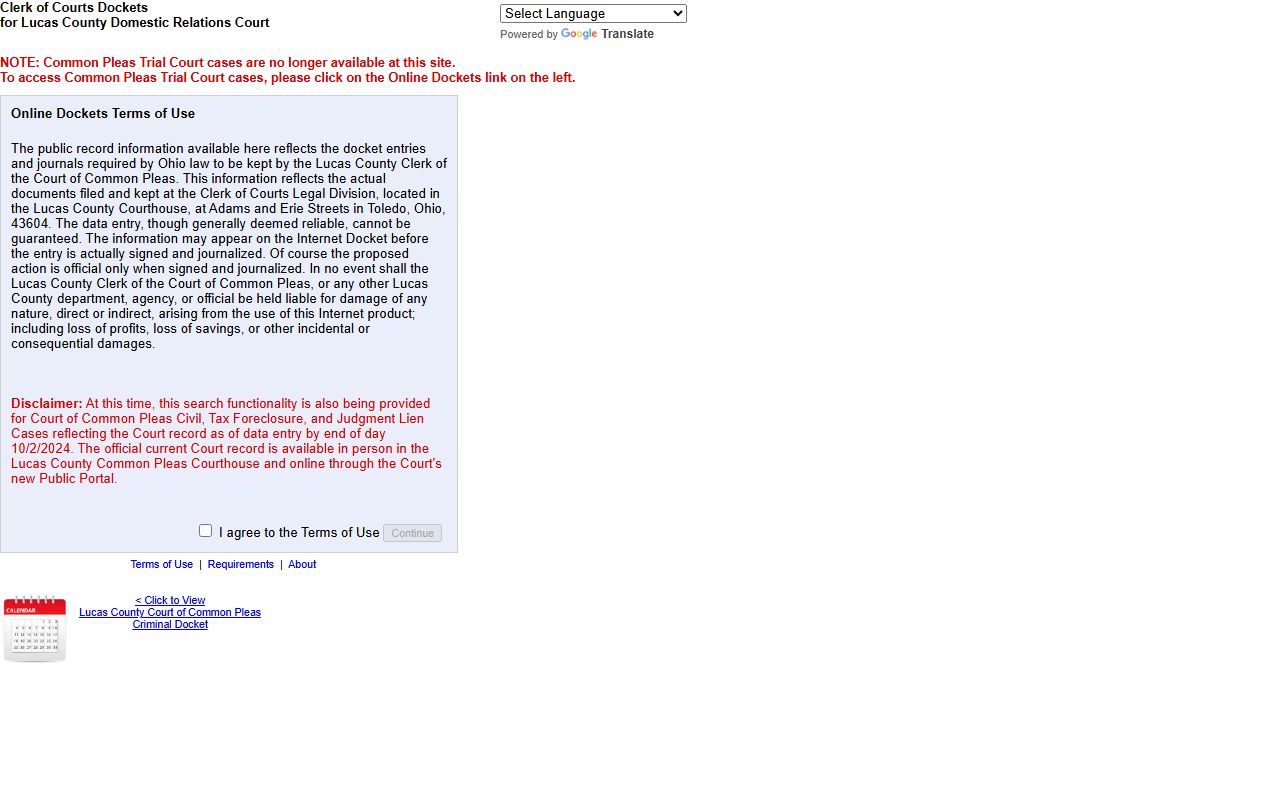
Its form offers a case-number path and a name or date-range path, with a Party Type dropdown for plaintiff or defendant.
The biggest point to grasp is the gap between a charge and a conviction. A charge is only an accusation. A conviction is a judgment that a person committed an offense. The disposition field shows the outcome, and the sentence or judgment shows what followed. A few terms come up again and again.
- Disposition
- The outcome of a charge or case, such as guilty, dismissed, or acquitted.
- Journal entry
- A formal written court entry that becomes official once a judge signs and journalizes it.
- Capias
- A bench warrant a court issues after a missed appearance or a violation of a court order.
- Continuance
- A postponed hearing or deadline pushed to a later date.
Accuracy and Record Limitations
Online records can lag behind the courtroom. The Domestic Relations terms say data may appear before an entry is signed and journalized, and the data is reliable but not guaranteed. The Criminal Division FAQ adds that it can take one to three days for the Journal Clerk to get an original order from the courtroom. The Booking Summary updates every four to six hours, so it may not match the live jail count.
If something looks wrong, go to the source. To fix inaccurate background-check information, the Clerk FAQ says to visit the Criminal File area on the 3rd floor at 700 Adams Street with photo ID, since this cannot be done by phone. For case status, call the right file room with a case number or name. The Common Pleas staff directory lists the office address, phone, fax, and hours.
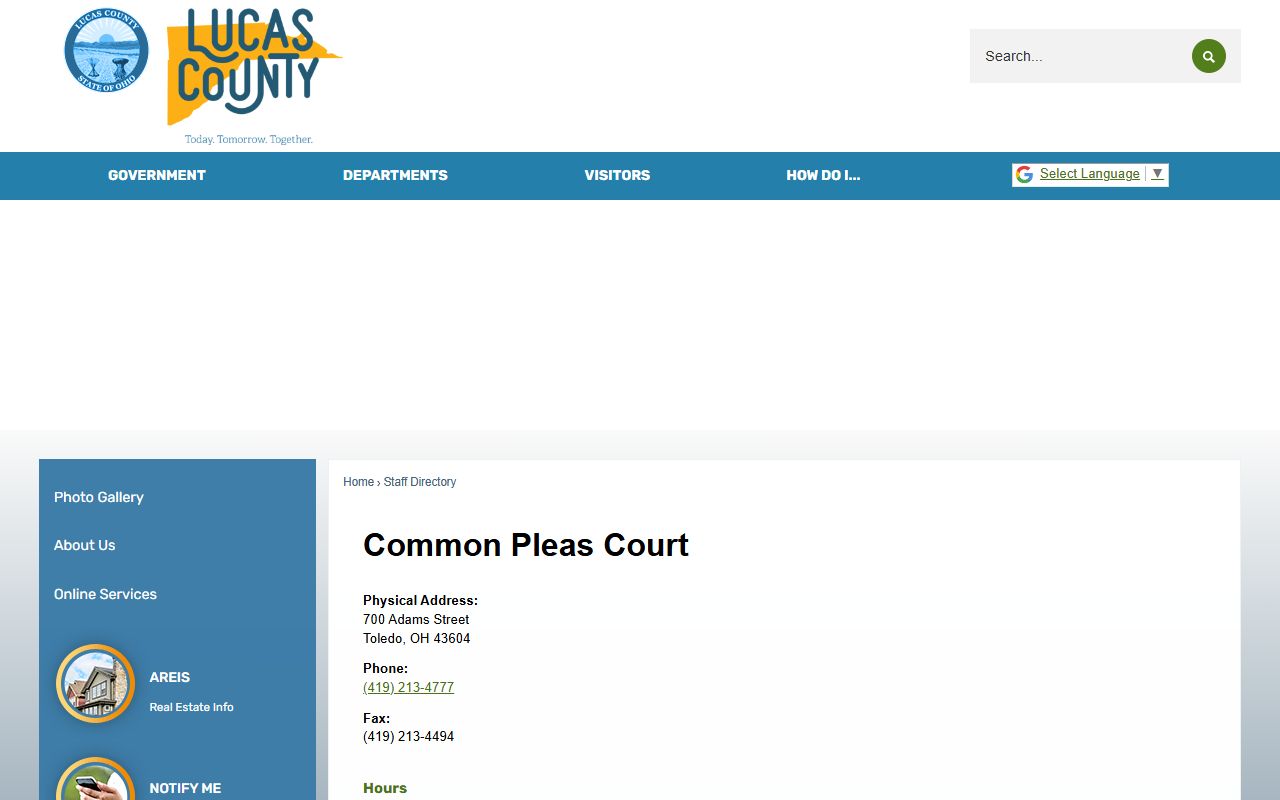
It also lists the case-information phone numbers, so you can reach the right division when an online entry needs confirming.
Note: Confirm any detail with the originating office before you rely on an online record, because portals can lag, omit sealed items, or show entries that are not yet final.
History of Lucas County Courts
Ohio's Common Pleas courts are constitutional courts, created under Article IV of the Ohio Constitution, with one in each of the state's 88 counties. Lucas County anchors its court center at 700 Adams Street in downtown Toledo, on a block bounded by Adams, Erie, Jackson, and Michigan Streets. The county created a separate Juvenile Division by statute in 1977, the same year the Corrections Center opened nearby.
Records access has modernized over time. Clerk J. Bernie Quilter, sworn in during 1999, launched a searchable online docket for Common Pleas records that reportedly drew more than one million hits in its first year. In January 2026, the General Trial Division moved its case information into Tyler's re:SearchOH and Justice Case Access, a major step toward a modern, account-based search system.
Self-Help and Legal Aid in Lucas County
Clerk staff can hand you forms, records, and procedural pointers, but they cannot give legal advice. Several local groups fill that gap for people who cannot afford a lawyer. The Clerk's FAQ lists referral and aid contacts, and the state offers self-help forms online. Pick the resource that fits your case type and income.
The Toledo Bar Association Lawyer Referral service can be reached at 419-242-2000. Legal Aid of Western Ohio serves eligible low-income residents at 419-724-0460, and Advocates for Basic Legal Equality is at 419-255-0814. For statewide self-help, use Ohio Legal Help, which posts plain-language forms and guides. Maumee Municipal Court lists a public defender line at 419-897-7082 for cases in its area.
Frequently Asked Questions
How do I know which Lucas County court handles my case?
Check the case number prefix and case type. The Clerk FAQ says CR, LR, or MS cases are Common Pleas at 700 Adams Street. DR or DM cases go to Domestic Relations. CL cases belong to the Sixth District Court of Appeals at One Constitution Avenue. Cases involving children under 18 go to the Juvenile Court Center on Spielbusch Avenue, reached at 419-213-6722. Municipal traffic and misdemeanor matters stay with the city court that issued them. Matching the prefix to the court points you to the correct search portal.
Are Lucas County court records available online?
Yes, for most adult cases. General Trial Division case information now runs through Tyler re:SearchOH and Justice Case Access, which both ask for a free account. Domestic Relations uses a separate online docket. The municipal courts each run their own case systems. Some full documents still need a portal account, a copy request, or an in-person visit, so a docket search does not always pull every filed image. The court records page lays out each portal in more detail.
What do copies of Lucas County court records cost?
It depends on the office. The Clerk's 2025 public-records policy lists paper copies at $0.05 per page and email delivery at no charge. The Criminal Division FAQ lists case copies at $0.10 per page. The Sheriff gives the first 10 pages free, then charges $0.10 per page, and bills dash or body camera video at $75 per hour produced. Confirm the rate with the division that holds your record before you order. Marriage and probate copies follow Probate Court's own process.
Where do I find a Lucas County inmate?
Use the Sheriff's Booking Summary, linked from the Lucas County Sheriff's site. It updates every four to six hours and lists name, charges, court, arresting agency, and current status. There is no name search form, so open the PDF and use your viewer's find tool. The inmate records page covers the roster in full. State prison inmates are searched through the Ohio Department of Rehabilitation and Correction, and federal inmates through the Bureau of Prisons locator.
Where do I get a marriage license or divorce record?
Marriage licenses come from the Lucas County Probate Court Marriage License Bureau, reached at 419-213-4361. Divorce records come from the Clerk of Courts Domestic Relations Division, reached at 419-213-6902. Marriage certified copies are mailed, not emailed or faxed, and Probate says to allow about three weeks. The marriage and divorce records page has fees and steps, and probate records covers estates and guardianships.
How do I seal or expunge a Lucas County record?
You file in the sentencing court. The Clerk FAQ gives a local starting point: a felony conviction generally needs a minimum three-year wait after probation, a misdemeanor one year, all costs and restitution paid, and a $50 filing fee. The Clerk has the forms, and the judge can still deny the request. Because Ohio's sealing law has changed often, confirm current eligibility under ORC 2953.32 and consider legal help before you file.
More on the Lucas County Court Records FAQ page.